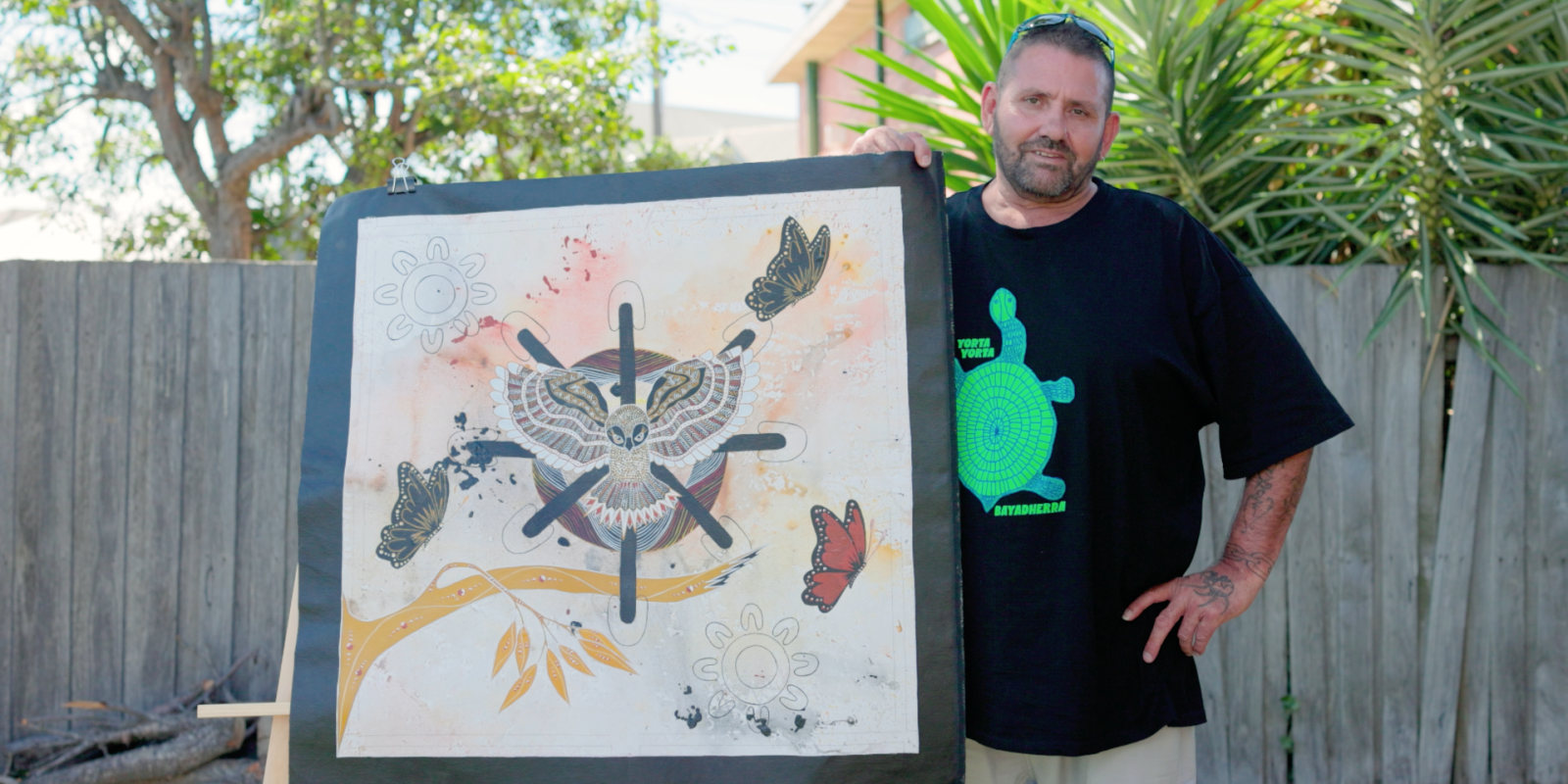
This year, The Torch is celebrating 10 years since the establishment of the Aboriginal Arts Policy.
The policy is the hard-won result of over 40 years of First Peoples advocacy and bipartisan political support. Launched in 2016, it allows First Peoples in prison to earn money from the sale of their artworks, if they’re connected to The Torch.
The majority of income earned by First Peoples in prison is held in a trust which can be accessed when the artist is released. A small amount is available to the artist while inside and any interest earnt from the income goes to The Victims of Crime Financial Assistance Scheme.
Development of the policy required support across the political spectrum in conjunction with the proven success of The Torch’s Indigenous Arts in Prison and Community Program. The policy was made possible through the coming together of the major parties, the corrections department, the Victorian Ombudsman, and the community, to create a solution to an entrenched problem.
This coming together despite differences has become something of a beacon of hope for all of us here at The Torch. Knowing that, despite the divisions we see here in Australia and across the world, this policy remains an opportunity for unity and connection.
Through this coming together across divides, we can support the financial self-determination and self-confidence of artists who in turn are able to support family from inside prison.
Ricky J’s Story
Ricky J is a Yorta Yorta artist who has been part of The Torch program since we began in 2011. Program Founder and Creative Director, Kent Morris, remembers when he first met Rick. Kent shared, “I remember seeing that he had ambition and talent, and a strong desire to reconnect with his family and the community.”
Recently Rick shared some of his story with us in a video interview. He shares how before being incarcerated, he didn’t have an art practice, or a particularly strong connection to culture; how connecting to culture and mob inside, and learning to paint, gave him a sense of belonging; and once the Aboriginal Art Policy was introduced, an opportunity to contribute financially to his family.
…the more I got into my culture and connecting to land and everything else, I felt alive, I felt that I belong. The more you learn about your culture, the more it makes you stronger.
The first time I went to jail I didn’t know nothing about art … And not long after, that’s when I met Kent Morris. I showed him the artwork and he goes, ‘don’t stop what you’re doing. You’ve got a gift’.
…now you earn an income and that sort of gives you a purpose in life, it helps you to believe in yourself more. You know, it makes you stand tall, it makes you stronger.”
And that’s what The Torch program, and the Aboriginal Art Policy, is all about:
Community-wide connection, walking alongside First Peoples as they deepen cultural connection, develop community, find a creative practice of their own to tell their story in their own style and voice.
To have the opportunity to share their art, their story, with the wider community, and through that, through exhibiting their work, having the opportunity to connect and to sell their work, the opportunity to think of themselves differently.
Ten years on from the launch of the policy
Since 2016 when the Aboriginal Art Policy was enacted, through to 2026, The Torch has generated over $7.5 million in income for more than 1,000 First Peoples artists connected to our program.
When the Aboriginal Art Policy was first enacted in 2016, The Torch presented Confined 7 which featured 140 artworks. This was the first Confined exhibition where artists in prison could earn income from the sale of their works.
Ten years on, and The Torch’s Confined series has continued to flourish with Confined 17 featuring 497 artworks by First Peoples artists in prison and those back in the community. Confined exhibitions over the past five years have sold 50–60% of exhibited works, generating significant income for artists each year.
The Torch is the only state-wide program in Australia that allows incarcerated artists to draw income from the sale and licensing of their artwork whilst on remand and sentenced. We do not take a commission on artwork sales, which means 100% of the sale price of artworks goes directly to the artist.
The Torch program contributes to reduced recidivism, family reunification, and improved mental health across the Victorian Aboriginal community. In fact, a 2022 report found that participants engaged with The Torch for just a year or more had a recidivism rate of 18%, compared with 53% for First Peoples and 43% for non-Indigenous prisoners.
Yet while we celebrate 10 years of the Aboriginal Art Policy and all that it’s made possible, we’re not resting on our laurels.
Recent changes to the bail laws are already seeing an increase in First Peoples on remand – that’s more mob incarcerated while awaiting trial – and in turn, a greater demand on our program.
And that’s where you can make an impact.
You can make a tax-deductible donation to The Torch and help turn policy into lifelong change – lower recidivism, stronger culture, and artists building futures on their own terms.
Donations to The Torch help strengthen and scale our long‑standing, community‑led and culturally grounded model – supporting First Peoples with lived experience of incarceration to reconnect with culture, develop artistic practice, and build pathways to meaningful economic and social participation.
For all enquiries, please contact Amelia Easdale, Fundraising and Development Manager, philanthropy@thetorch.org.au or call (03) 9042 1236.