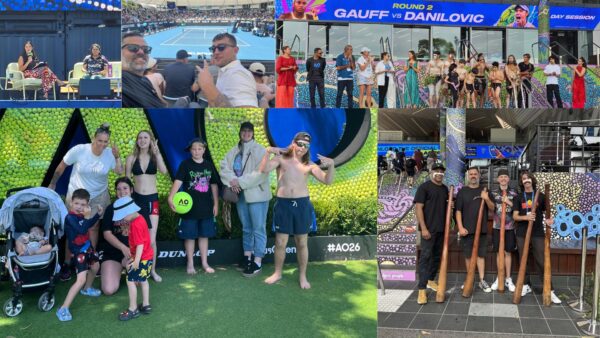
Artists and a small group of staff from The Torch visited the Australian Open on Evonne Goolagong Cawley Day this week.
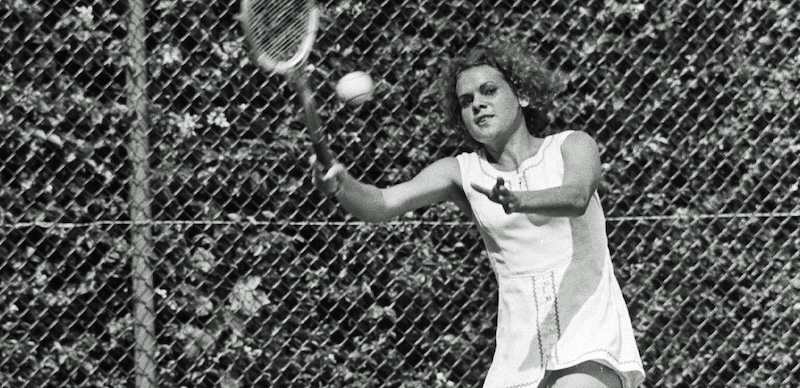
Formerly known as the Australian Open’s First Nations Day, the day was renamed to celebrate Evonne Goolagong Cawley, the first Indigenous woman to compete on the international tennis stage. A proud Wiradjuri woman born in rural New South Wales, Evonne’s journey is a powerful example of perseverance and Blak excellence in a traditionally white space.
Despite facing racism, limited resources, and social barriers, Evonne’s talent and determination set her apart. After being spotted by a tennis coach, Evonne went on to compete on the world stage winning seven Grand Slam singles titles and more than 120 titles overall between 1971 and 1980. Throughout her career, Evonne carried herself with humility and pride, remaining deeply connected to her culture and continuing to inspire generations through her resilience and sporting excellence.
We don’t need to look far to see countless examples of perseverance and Blak excellence, many within The Torch program itself.
Each year, we engage over 800 First Peoples artists with lived experience of incarceration. Despite the ongoing overincarceration of First Peoples in Australia’s legal system, we continue to see profound stories of resilience, creativity, and hope emerge. Artists in The Torch program actively reclaim and maintain cultural connection and knowledge, even in the face of incarceration. Their artworks embody Blak excellence not only through visual expression but through the powerful stories they tell.
One such story is shared by Yorta Yorta/Dja Dja Wurrung artist Uncle Leon in his painting Old Rumbalara Settlement which reflects on the Cummeragunja Walk Off in 1939.
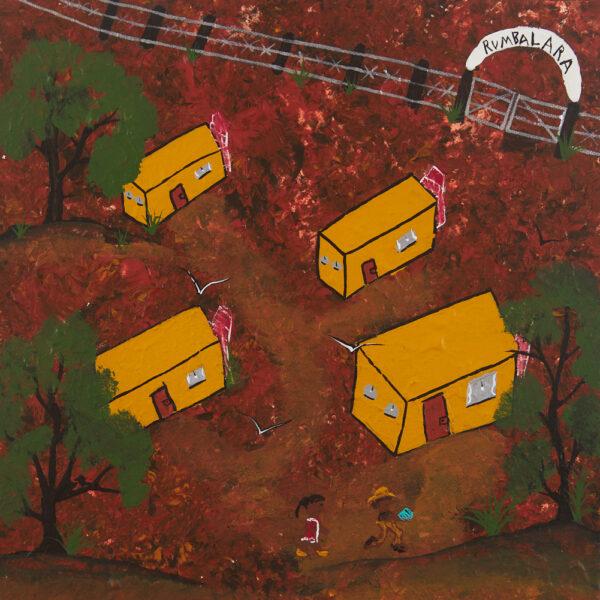
My family lived on the riverbank near Mooroopna and that was called The Flats,” Uncle Leon says. “They walked off Cummeragunja mission in 1939 and walked from the township of Barmah to the township of Mooroopna and settled on the riverbank.”
Conditions at the Cummeragunja mission were harsh and unjust. Workers were given unhealthy and inadequate rations, children were removed and forced into domestic work, and illnesses like tuberculosis spread through the station. In his painting, Uncle Leon depicts concrete shelters within a fenced environment on red earth. The shelters “were all made out of concrete, the walls, roof and floor,” he explains.
They built the concrete floor because they didn’t want to give us floorboards – they thought we would pull up the floorboards for firewood. The concrete shelters were very cold in winter and very hot in summer.”
On 4 February 1939, 200 residents walked out of the station in protest. It was one of the earliest mass protests of First Peoples in Australia and went on to inspire action across the country for years to come.
Stories like these remind us to stand strong on Invasion Day and to use every day as an opportunity to celebrate Blak excellence and perseverance.
If you’re looking for more examples of Blak excellence, explore over 1,000 artworks available through our online shop, or visit The Torch Gallery Tuesday to Friday to see these works in person. 100% of each artwork sale goes directly to the artist.